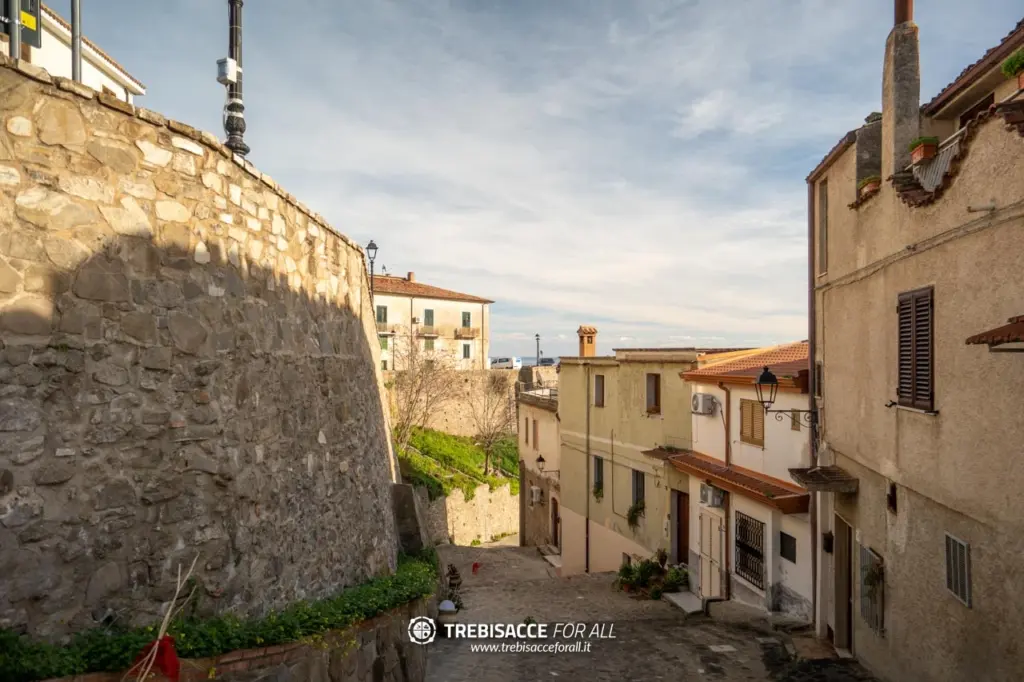
Climbing towards the Bastion, one has the feeling of changing perspective, not just altitude. It is the buttress that for centuries protected the historical center, the extreme line beyond which the horizon began. Born in the 16th century as a defensive garrison, today it guards something equally precious: the memory of the landscape and the awareness of an ancient balance.
From here, the gaze embraces a “perfect geographical page”. The plain of Sibari stretches out orderly, the Ionian Sea opens towards the entire Gulf of Taranto, the ridges of the Upper Ionian trace a natural frame. It is a point where one understands that Trebisacce is not just a coastal city, but a node of relations between sea, countryside, and historical center.
The Bastion is symbolically a border, but it is also what conjoins. It is the line of contact between seafaring culture and peasant culture, between the fatigue of the nets and that of the fields. On one side the Ionian, with its routes and its departures; on the other the cultivated land, with its seasonal rhythms and the patience of sowing.
Observing from above means understanding the connections. The historical center behind, the countryside stretching towards the inland, the sea opening towards the Mediterranean: everything becomes part of a single territorial narrative. The panoramic telescope is not just a tourist tool, but an invitation to read the landscape as a text. Every line of the coast, every agricultural weave, every relief tells a stratification of choices and of lives.
The Bastion no longer defends the city from an external enemy. It defends its identity. It is the point where one becomes aware that the border is not separation, but a place of encounter. Between sea and land, between memory and project, between past and future. Looking from here means assuming a responsibility: to guard the balance that made this history possible and to continue writing it.